русский
 Español
 中文简体
中文简体

Non-Standard Custom Fasteners for Specialized Industrial Requirements Standard screws and fasteners are suitable for many general assembly applications, but modern industrial equipment often requires ...
READ MORENon-Standard Taper Pins Manufacturer
-
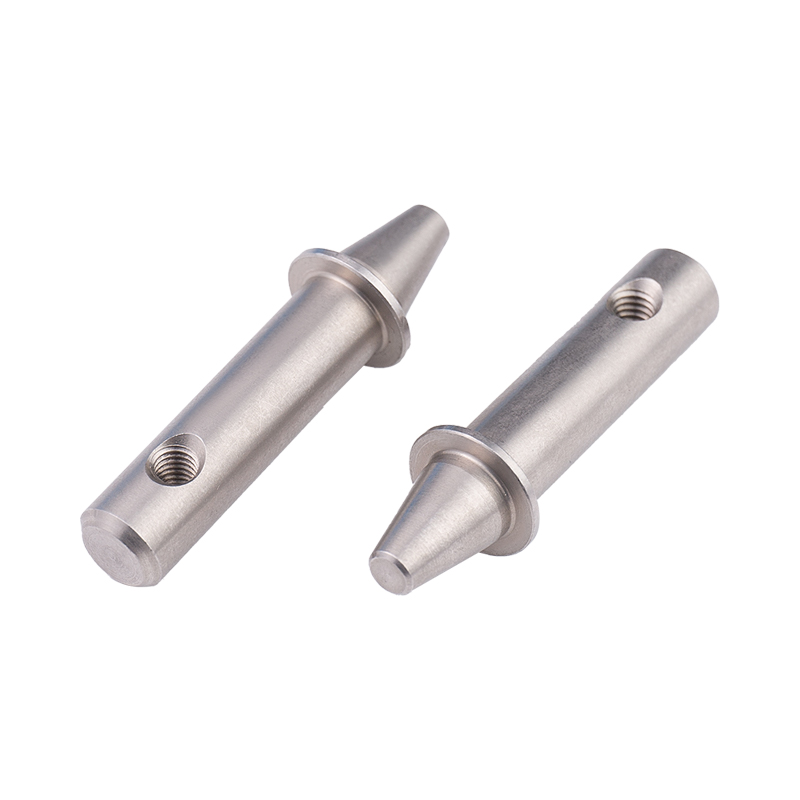
HYS-0058
-
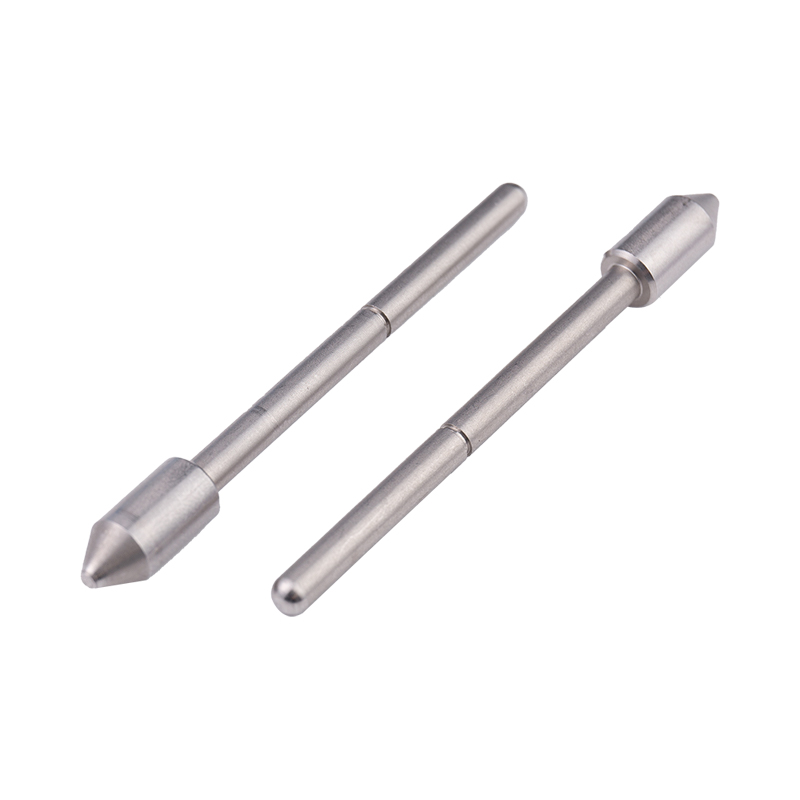
HYS-0059
-
HYS-0060
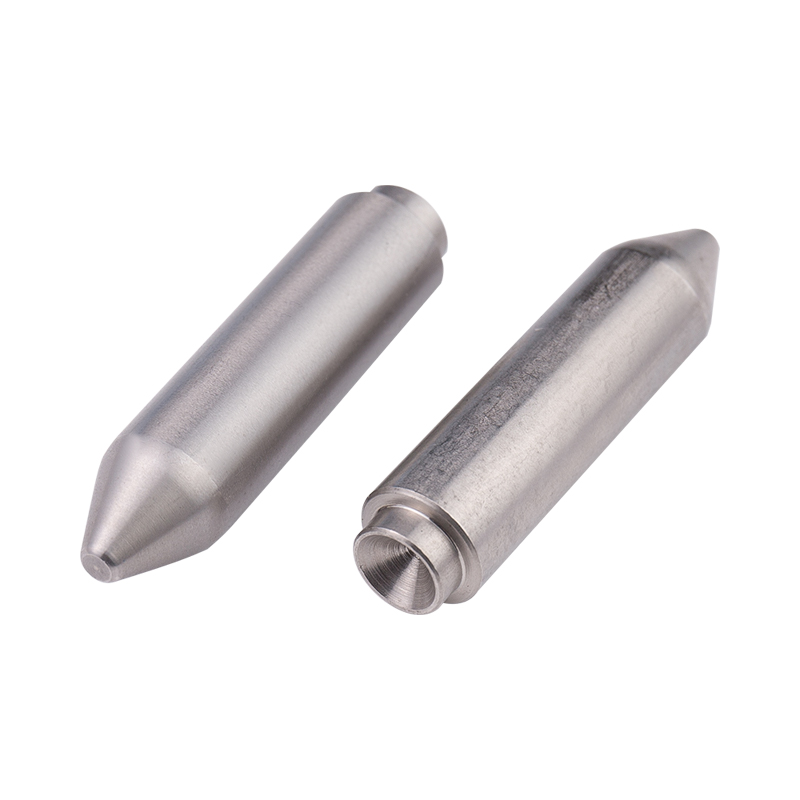
Non-standard taper pins are commonly used to connect or fix two components, allowing them to rotate or be relatively fixed. They have a conical shape with a top and bottom end and are typically used for connections or positioning requiring high precision. Compared to standard parts, non-standard taper pins have different dimensions, shapes, or special customization requirements. They can be altered in terms of partial or overall structure, dimensions, appearance, and material. Non-standard taper pins are designed and manufactured according to specific application requirements to meet your engineering needs. They are widely used in mechanical, automotive, aerospace, and other industrial fields where high precision and special requirements are crucial for the performance of connecting components.
We have our own Non-Standard Taper Pins factory in China, so we can OEM/ODM standard and non-standard fasteners, Precision Hardware Parts and accessories. We export and wholesale Non-Standard Taper Pins since 2006.
About
Kunshan Hong Yong Sheng Precision Hardware Products Co.,Ltd.
Kunshan Hong Yongsheng Precision Hardware Products Co., Ltd. was established in September 2006, is a professional China Non-Standard Taper Pins manufacturer and factory, the production of various types of precision parts, PEM series of standard fasteners, non-standard parts of the custom enterprise, the company's production equipment imported from Japan CNC computer numerically-controlled lathes, Taiwan CAM walking knife type high-precision automatic lathes, and various types of auxiliary equipment, precision testing equipment, totaling more than 100 units, monthly output of up to 5 million pieces. Our products are used in many fields such as electronic communications, computer monitors and chassis, automotive parts, 3C household appliances, medical equipment, pneumatic machinery, sports equipment, furniture, lighting, aerospace, military, photovoltaic, intelligent industry and so on, and we have the technical ability to develop new products.
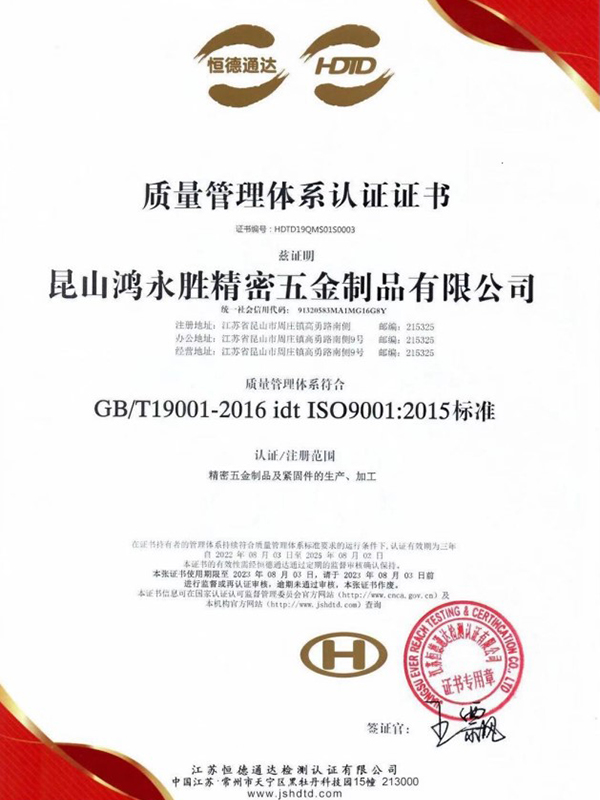
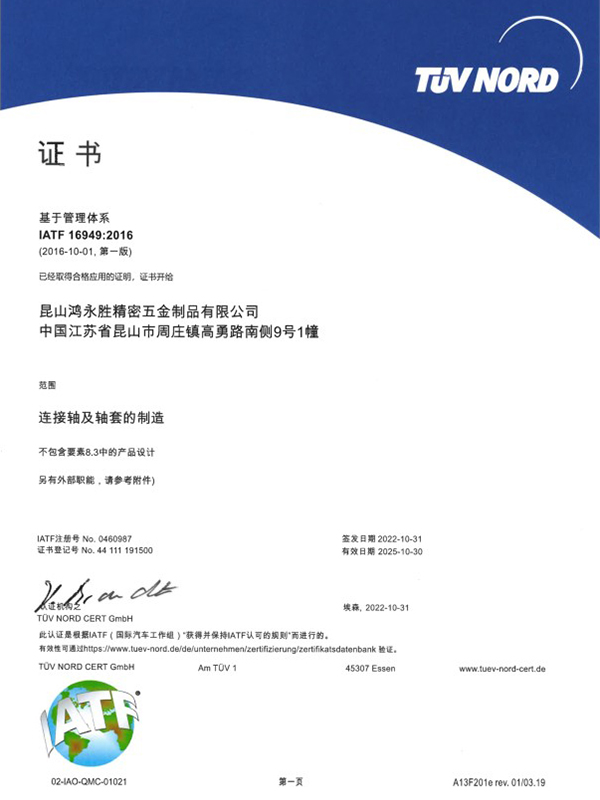
The company has obtained two quality system management certificates of ISO9001:2015 and IATF16949:2016.
At present, the company has been for Japan, Sweden, the United States, Singapore, Malaysia, Hong Kong and the Pearl River Delta and many other customers to provide services, now the main customers are: Japan Sharp (SHARP), Japan SMC, Japan Panasonic (Panasonic), the Swedish automobile VOVOL, etc., all the fixed assets investment of more than 30 million dollars, welcome friends from all walks of life to the factory to visit, study, consulting and come! We welcome friends from all walks of life to visit our factory, investigate, consult and come to us for sample processing.
We are looking forward to establishing a good business partnership with you with mutual trust and reciprocity!
The company has obtained two quality system management certificates of ISO9001:2015 and IATF16949:2016.
At present, the company has been for Japan, Sweden, the United States, Singapore, Malaysia, Hong Kong and the Pearl River Delta and many other customers to provide services, now the main customers are: Japan Sharp (SHARP), Japan SMC, Japan Panasonic (Panasonic), the Swedish automobile VOVOL, etc., all the fixed assets investment of more than 30 million dollars, welcome friends from all walks of life to the factory to visit, study, consulting and come! We welcome friends from all walks of life to visit our factory, investigate, consult and come to us for sample processing.
We are looking forward to establishing a good business partnership with you with mutual trust and reciprocity!
Certificate Of Honor
News
-
-
Imagine you are sourcing a precision shaft that carries a bearing on one end and slides through a hydraulic seal along its length. The drawing shows a circularity tolerance of 0.01 mm on the bearing ...
READ MORE -
What Is a Steel Sleeve and Where It Is Used A steel sleeve is a hollow cylindrical component used to protect a shaft, reduce friction, provide a wear-resistant bearing surface, or act as a spacer betw...
READ MORE -
When you have a batch of cylindrical components to machine, the CNC turning lathe is usually the first machine tool that comes to mind. It solves a straightforward problem: rotate the workpiece while...
READ MORE
Non-Standard Taper Pins Industry knowledge
How do non-standard taper pins compare to other types of fasteners or connectors in terms of performance and versatility?
Non-standard taper pins are designed to provide a precise and snug fit between components, ensuring minimal play or movement once installed. This precision fit is crucial for applications where alignment and stability are paramount.
Due to their conical shape and wedging action, non-standard taper pins can withstand high axial and shear loads, making them suitable for heavy-duty applications where other fasteners may fail.
Non-standard taper pins have a self-locking feature, meaning that once installed, they resist loosening or disengagement due to vibrations or external forces, enhancing the overall reliability and safety of the assembly.
Compared to some other fastening methods like bolts or screws, non-standard taper pins require minimal space for installation, making them ideal for applications where compactness is crucial.
Depending on the material used, non-standard taper pins can offer excellent corrosion resistance, making them suitable for use in harsh environments or outdoor applications where exposure to moisture or chemicals is a concern.
Non-standard taper pins can be tailored to meet specific application requirements in terms of size, shape, material, and other parameters, offering versatility and flexibility in design and implementation.
Once the tapered hole is prepared, non-standard taper pins can be easily installed using simple tools, reducing assembly time and labor costs compared to some complex fastening methods.
While non-standard taper pins may have higher upfront costs compared to some standard fasteners, their long-term performance, reliability, and reduced maintenance requirements can often justify the investment, resulting in overall cost savings over the lifespan of the application.
What factors influence the cost of designing and manufacturing non-standard taper pins?
The choice of material for the non-standard taper pins plays a significant role in determining the cost. High-quality materials with specific properties, such as strength, corrosion resistance, or temperature resistance, may be more expensive than standard materials.
The level of customization needed for the non-standard taper pins directly impacts the cost. Complex designs, unique shapes, precise tolerances, or special surface finishes may require additional manufacturing processes, specialized tooling, or manual labor, all of which can increase costs.
The volume of non-standard taper pins being produced affects the overall cost. Mass production typically leads to economies of scale, reducing per-unit costs. Conversely, small-batch or one-off production runs may incur higher costs due to setup and tooling expenses.
Tighter tolerances and higher precision requirements result in increased manufacturing complexity and potentially higher costs. Achieving extremely precise dimensions and surface finishes often requires advanced machining techniques and additional quality control measures.
The chosen manufacturing processes significantly impact the cost. Machining, grinding, EDM (Electrical Discharge Machining), or other specialized processes may be required depending on the material and design specifications, each with its associated costs.
Labor costs, including skilled machining operators and technicians, contribute to the overall cost of manufacturing non-standard taper pins. Complex designs or manual finishing processes may require more labor hours, increasing production costs.
The need for specialized tooling, fixtures, or equipment for manufacturing non-standard taper pins can add to the upfront costs. Investment in CNC machines, EDM equipment, or custom tooling may be necessary for certain designs, impacting overall production costs.

If you are interested in our products, please consult us
Kunshan Hong Yong Sheng Precision Hardware Products Co.,Ltd. All Rights Reserved. OEM/ODM Non-Standard Taper Pins Manufacturer