русский
 Español
 中文简体
中文简体

Non-Standard Custom Fasteners for Specialized Industrial Requirements Standard screws and fasteners are suitable for many general assembly applications, but modern industrial equipment often requires ...
READ MOREAutomotive Stainless Steel Retaining Pins Manufacturer
-
HYS-0113
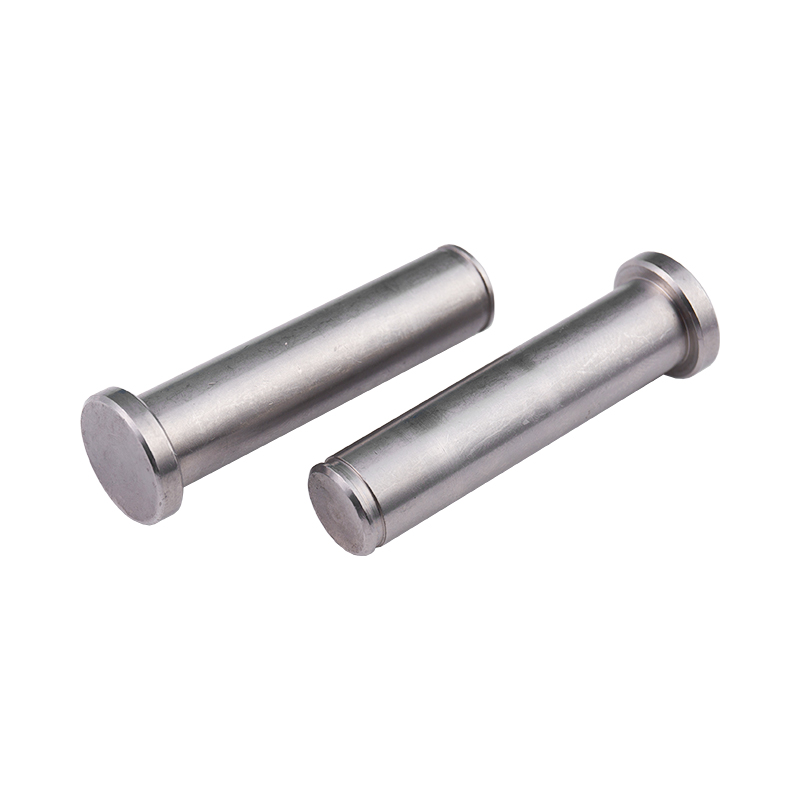
Automotive stainless steel retaining pins have high strength and are not easily damaged, which allows the stainless steel retaining pins to withstand greater tension and pressure. Whether it is fixing engine mounts, suspension arms or other key components, stainless steel fixing pins can provide reliable connection and support to ensure stable operation of the car under various working conditions. Stainless steel is easy to process and form, and can be easily made into fixed pins of various shapes and sizes. Its maintenance is also relatively simple, requiring only regular cleaning and inspection.
We have our own Automotive Stainless Steel Retaining Pins factory in China, so we can OEM/ODM standard and non-standard fasteners, Precision Hardware Parts and accessories. We export and wholesale Automotive Stainless Steel Retaining Pins since 2006.
About
Kunshan Hong Yong Sheng Precision Hardware Products Co.,Ltd.
Kunshan Hong Yongsheng Precision Hardware Products Co., Ltd. was established in September 2006, is a professional China Automotive Stainless Steel Retaining Pins manufacturer and factory, the production of various types of precision parts, PEM series of standard fasteners, non-standard parts of the custom enterprise, the company's production equipment imported from Japan CNC computer numerically-controlled lathes, Taiwan CAM walking knife type high-precision automatic lathes, and various types of auxiliary equipment, precision testing equipment, totaling more than 100 units, monthly output of up to 5 million pieces. Our products are used in many fields such as electronic communications, computer monitors and chassis, automotive parts, 3C household appliances, medical equipment, pneumatic machinery, sports equipment, furniture, lighting, aerospace, military, photovoltaic, intelligent industry and so on, and we have the technical ability to develop new products.
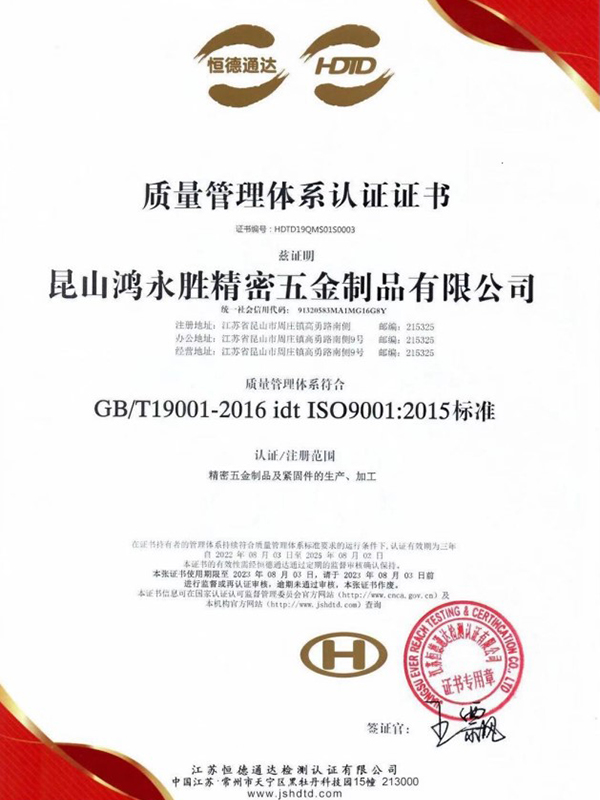
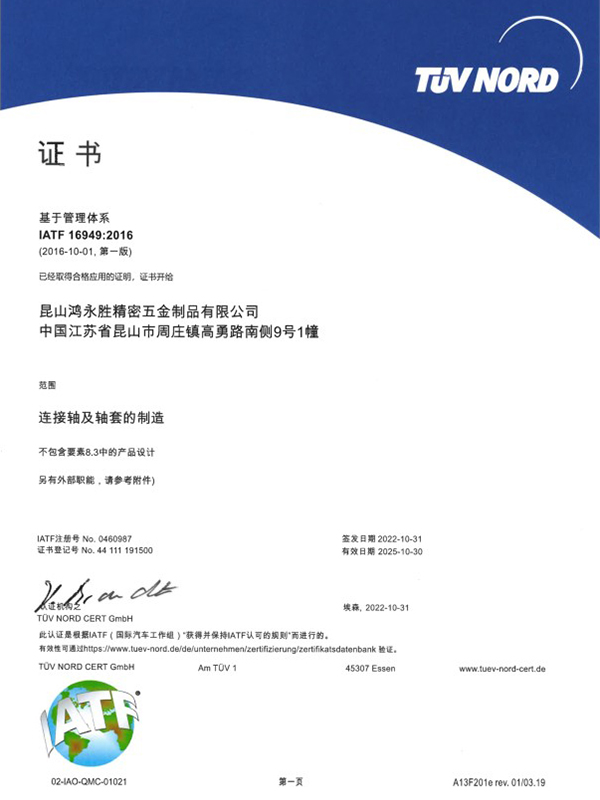
The company has obtained two quality system management certificates of ISO9001:2015 and IATF16949:2016.
At present, the company has been for Japan, Sweden, the United States, Singapore, Malaysia, Hong Kong and the Pearl River Delta and many other customers to provide services, now the main customers are: Japan Sharp (SHARP), Japan SMC, Japan Panasonic (Panasonic), the Swedish automobile VOVOL, etc., all the fixed assets investment of more than 30 million dollars, welcome friends from all walks of life to the factory to visit, study, consulting and come! We welcome friends from all walks of life to visit our factory, investigate, consult and come to us for sample processing.
We are looking forward to establishing a good business partnership with you with mutual trust and reciprocity!
The company has obtained two quality system management certificates of ISO9001:2015 and IATF16949:2016.
At present, the company has been for Japan, Sweden, the United States, Singapore, Malaysia, Hong Kong and the Pearl River Delta and many other customers to provide services, now the main customers are: Japan Sharp (SHARP), Japan SMC, Japan Panasonic (Panasonic), the Swedish automobile VOVOL, etc., all the fixed assets investment of more than 30 million dollars, welcome friends from all walks of life to the factory to visit, study, consulting and come! We welcome friends from all walks of life to visit our factory, investigate, consult and come to us for sample processing.
We are looking forward to establishing a good business partnership with you with mutual trust and reciprocity!
Certificate Of Honor
News
-
-
Imagine you are sourcing a precision shaft that carries a bearing on one end and slides through a hydraulic seal along its length. The drawing shows a circularity tolerance of 0.01 mm on the bearing ...
READ MORE -
What Is a Steel Sleeve and Where It Is Used A steel sleeve is a hollow cylindrical component used to protect a shaft, reduce friction, provide a wear-resistant bearing surface, or act as a spacer betw...
READ MORE -
When you have a batch of cylindrical components to machine, the CNC turning lathe is usually the first machine tool that comes to mind. It solves a straightforward problem: rotate the workpiece while...
READ MORE
Automotive Stainless Steel Retaining Pins Industry knowledge
How to ensure the dimensional accuracy of automotive stainless steel retaining pins during machining?
During the machining process, it is crucial to ensure the dimensional accuracy of automotive stainless steel retaining pins. Here are a few key steps and considerations to ensure its dimensional accuracy:
Choose the right machine tools and cutting tools: The accuracy of the machine tools and cutting tools directly determines the dimensional accuracy of the workpiece. Therefore, high-precision, high-stability machine tools should be selected, as well as cutting tools suitable for stainless steel materials. Tools should be sharp and wear-resistant to reduce errors during processing.
Strictly control cutting parameters: Cutting parameters such as cutting speed, feed rate and cutting depth have an important impact on the dimensional accuracy of the workpiece. Appropriate cutting parameters should be selected based on the characteristics and processing requirements of stainless steel materials, and their variation range should be strictly controlled.
Use appropriate measurement methods: During the machining process, high-precision measuring tools (such as vernier calipers, micrometers, microscopes, etc.) should be used regularly to measure the dimensions of the fixed pins. This helps to detect and correct machining errors in time and ensure the dimensional accuracy of the fixed pins.
Adjust and optimize process parameters: Depending on the actual situation during the machining process, it may be necessary to adjust and optimize process parameters, such as cutting speed, feed amount, cutting depth, coolant flow, etc. These adjustments should be based on the dimensional accuracy requirements of the workpiece and the characteristics of the stainless steel material.
Ensure the stability of machine tools and fixtures: The stability of machine tools and fixtures has a great impact on the dimensional accuracy of machined parts. Therefore, the rigidity and stability of machine tools and fixtures should be ensured to reduce vibration and deformation during processing.
Use advanced processing technology: With the advancement of science and technology, some advanced processing technologies (such as CNC processing, laser processing, etc.) are gradually used in the processing of stainless steel fixed pins. These technologies can significantly improve processing accuracy and efficiency and reduce processing errors.
Strengthen quality control and testing: During the processing process, quality control and testing should be strengthened, and processed parts should be regularly tested and evaluated. This helps to detect and correct processing errors in time to ensure that the dimensional accuracy of the fixed pin meets the requirements.
Ensuring the dimensional accuracy of automotive stainless steel fixing pins requires comprehensive consideration of machine tools, cutting tools, cutting parameters, measurement methods, process parameters, the stability of machine tools and fixtures, and processing technology. By strictly controlling and optimizing these aspects, the dimensional accuracy and processing quality of fixed pins can be significantly improved.

If you are interested in our products, please consult us
Kunshan Hong Yong Sheng Precision Hardware Products Co.,Ltd. All Rights Reserved. OEM/ODM Automotive Stainless Steel Retaining Pins Manufacturer