русский
 Español
 中文简体
中文简体

Non-Standard Custom Fasteners for Specialized Industrial Requirements Standard screws and fasteners are suitable for many general assembly applications, but modern industrial equipment often requires ...
READ MORENon-Standard Aluminum Nuts Manufacturer
-
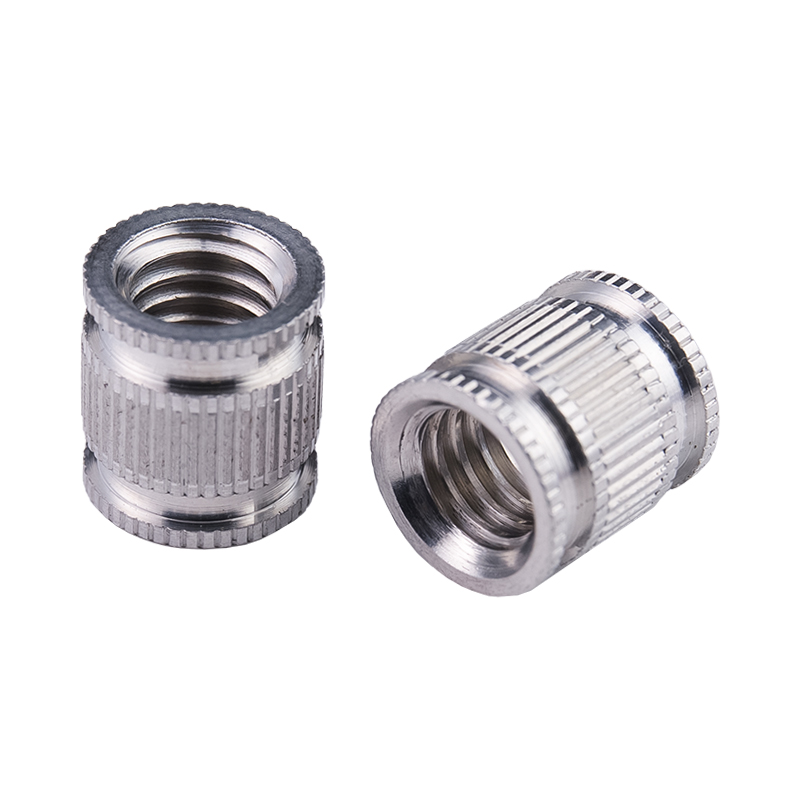
HYS-0053
-
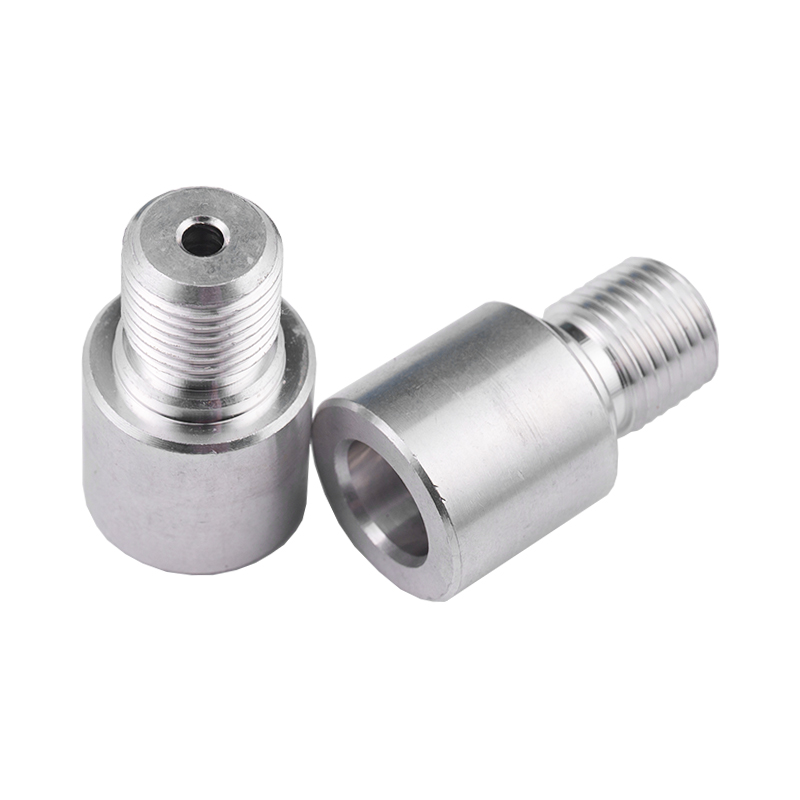
HYS-0054
-
HYS-0245
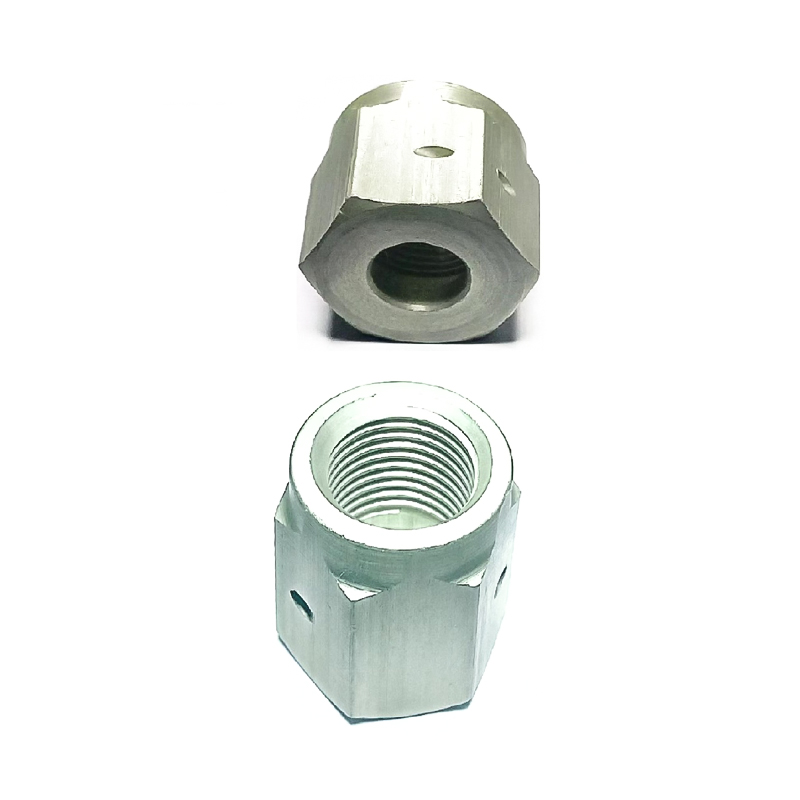
Aluminium nut is a nut made of aluminium, which has small specific gravity, light weight, good thermal conductivity, small coefficient of thermal expansion, good corrosion resistance and strong oxidation resistance compared with ordinary steel nuts. It is widely used in automobiles, motorbikes, aerospace, mechanical equipment, electronic products and other fields.
We have our own Non-Standard Aluminum Nuts factory in China, so we can OEM/ODM standard and non-standard fasteners, Precision Hardware Parts and accessories. We export and wholesale Non-Standard Aluminum Nuts since 2006.
About
Kunshan Hong Yong Sheng Precision Hardware Products Co.,Ltd.
Kunshan Hong Yongsheng Precision Hardware Products Co., Ltd. was established in September 2006, is a professional China Non-Standard Aluminum Nuts manufacturer and factory, the production of various types of precision parts, PEM series of standard fasteners, non-standard parts of the custom enterprise, the company's production equipment imported from Japan CNC computer numerically-controlled lathes, Taiwan CAM walking knife type high-precision automatic lathes, and various types of auxiliary equipment, precision testing equipment, totaling more than 100 units, monthly output of up to 5 million pieces. Our products are used in many fields such as electronic communications, computer monitors and chassis, automotive parts, 3C household appliances, medical equipment, pneumatic machinery, sports equipment, furniture, lighting, aerospace, military, photovoltaic, intelligent industry and so on, and we have the technical ability to develop new products.
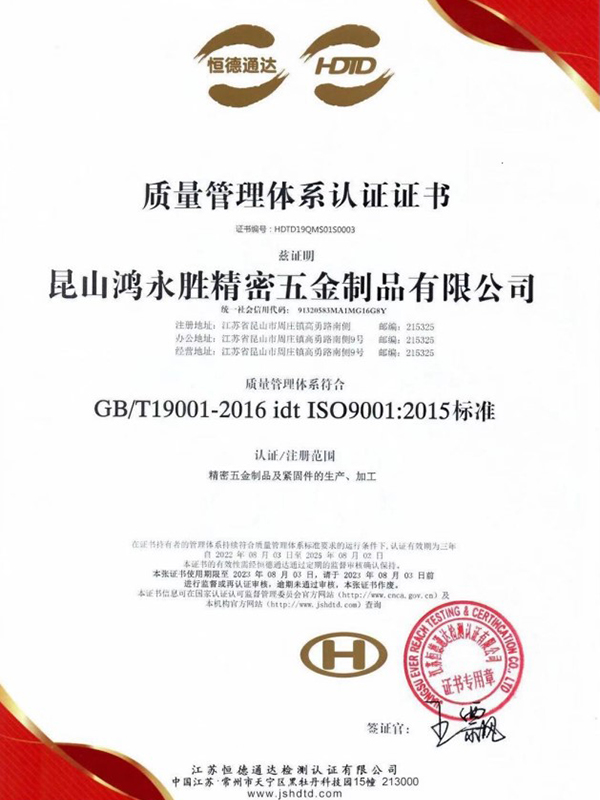
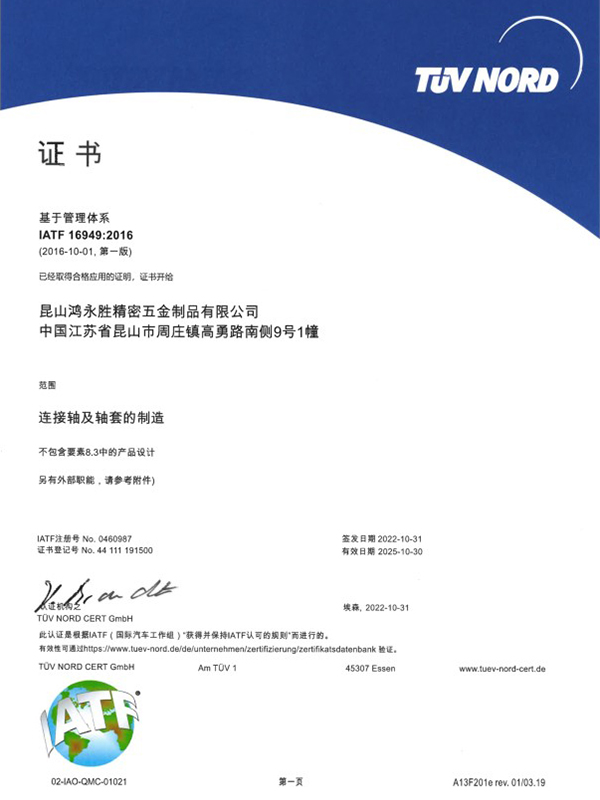
The company has obtained two quality system management certificates of ISO9001:2015 and IATF16949:2016.
At present, the company has been for Japan, Sweden, the United States, Singapore, Malaysia, Hong Kong and the Pearl River Delta and many other customers to provide services, now the main customers are: Japan Sharp (SHARP), Japan SMC, Japan Panasonic (Panasonic), the Swedish automobile VOVOL, etc., all the fixed assets investment of more than 30 million dollars, welcome friends from all walks of life to the factory to visit, study, consulting and come! We welcome friends from all walks of life to visit our factory, investigate, consult and come to us for sample processing.
We are looking forward to establishing a good business partnership with you with mutual trust and reciprocity!
The company has obtained two quality system management certificates of ISO9001:2015 and IATF16949:2016.
At present, the company has been for Japan, Sweden, the United States, Singapore, Malaysia, Hong Kong and the Pearl River Delta and many other customers to provide services, now the main customers are: Japan Sharp (SHARP), Japan SMC, Japan Panasonic (Panasonic), the Swedish automobile VOVOL, etc., all the fixed assets investment of more than 30 million dollars, welcome friends from all walks of life to the factory to visit, study, consulting and come! We welcome friends from all walks of life to visit our factory, investigate, consult and come to us for sample processing.
We are looking forward to establishing a good business partnership with you with mutual trust and reciprocity!
Certificate Of Honor
News
-
-
Imagine you are sourcing a precision shaft that carries a bearing on one end and slides through a hydraulic seal along its length. The drawing shows a circularity tolerance of 0.01 mm on the bearing ...
READ MORE -
What Is a Steel Sleeve and Where It Is Used A steel sleeve is a hollow cylindrical component used to protect a shaft, reduce friction, provide a wear-resistant bearing surface, or act as a spacer betw...
READ MORE -
When you have a batch of cylindrical components to machine, the CNC turning lathe is usually the first machine tool that comes to mind. It solves a straightforward problem: rotate the workpiece while...
READ MORE
Non-Standard Aluminum Nuts Industry knowledge
How do you properly install and torque non-standard aluminum nuts to ensure proper functionality and safety?
Before installation, ensure that the threads on both the nut and the bolt or stud are clean and free of any debris, dirt, or grease. This helps to ensure proper engagement and torque accuracy.
Use appropriate tools for installation, such as a calibrated torque wrench. Avoid impact tools, as they can apply uneven or excessive force, potentially damaging the nut or the mating surface.
Depending on the specific application and the type of aluminum nut being used, applying a suitable lubricant to the threads may be necessary to prevent galling or seizing during installation. However, be cautious not to over-lubricate, as this can affect torque accuracy.
Initially, hand tighten the nut onto the bolt or stud until it makes contact with the mating surface.
Using a torque wrench, apply the specified torque gradually and evenly in a clockwise direction. Refer to the manufacturer's recommendations or engineering specifications for the appropriate torque value.
After torquing, recheck the torque using the torque wrench to ensure that it matches the specified value. This helps to confirm that the nut has been properly tightened and will provide adequate clamping force.
Inspect the nut to ensure that it is fully engaged with the bolt or stud and that there are no signs of cross-threading or misalignment.
Once the nut is properly torqued and secured, verify that the assembly is functioning as intended and that there are no signs of loosening or movement.
Depending on the application and material properties, non-standard aluminum nuts may experience some settling or relaxation over time. Periodically inspect and re-torque the nuts as necessary to maintain proper clamping force and functionality.
How do factors such as corrosion, oxidation, and fatigue affect the durability of non-standard aluminum nuts over time?
Aluminum is naturally resistant to corrosion due to its ability to form a protective oxide layer on its surface. However, in certain environments, such as those with high levels of moisture, salt, or acidic substances, aluminum nuts can still corrode, particularly if the oxide layer is compromised. Corrosion can weaken the structural integrity of the nut, leading to premature failure or reduced clamping force.
While aluminum's oxide layer provides corrosion resistance, it can also be susceptible to oxidation in certain conditions, such as high temperatures or exposure to oxygen-rich environments. Oxidation can lead to the formation of aluminum oxide (alumina) on the surface of the nut, which may affect its appearance and potentially impair its functionality if not properly managed.
Like any material, aluminum is susceptible to fatigue failure when subjected to repeated loading and unloading cycles, especially if the applied loads are near or exceed the material's fatigue strength. Fatigue cracks can initiate at stress concentration points, such as threads or surface imperfections, and propagate over time, ultimately leading to failure of the nut.
To mitigate the effects of these factors and enhance the durability of non-standard aluminum nuts:
Use aluminum alloys with enhanced corrosion resistance, such as those specifically designed for marine or aerospace applications.
Apply surface treatments or coatings, such as anodizing or protective coatings, to improve corrosion and oxidation resistance.
Design nuts with smooth, rounded thread profiles and minimize stress concentrations to reduce the likelihood of fatigue initiation.
Implement proper installation techniques, including using appropriate torque values and lubrication, to ensure optimal performance and longevity.

If you are interested in our products, please consult us
Kunshan Hong Yong Sheng Precision Hardware Products Co.,Ltd. All Rights Reserved. OEM/ODM Non-Standard Aluminum Nuts Manufacturer