русский
 Español
 中文简体
中文简体

Non-Standard Custom Fasteners for Specialized Industrial Requirements Standard screws and fasteners are suitable for many general assembly applications, but modern industrial equipment often requires ...
READ MOREAutomotive Rivet Nuts Manufacturer
-
HYS-0096
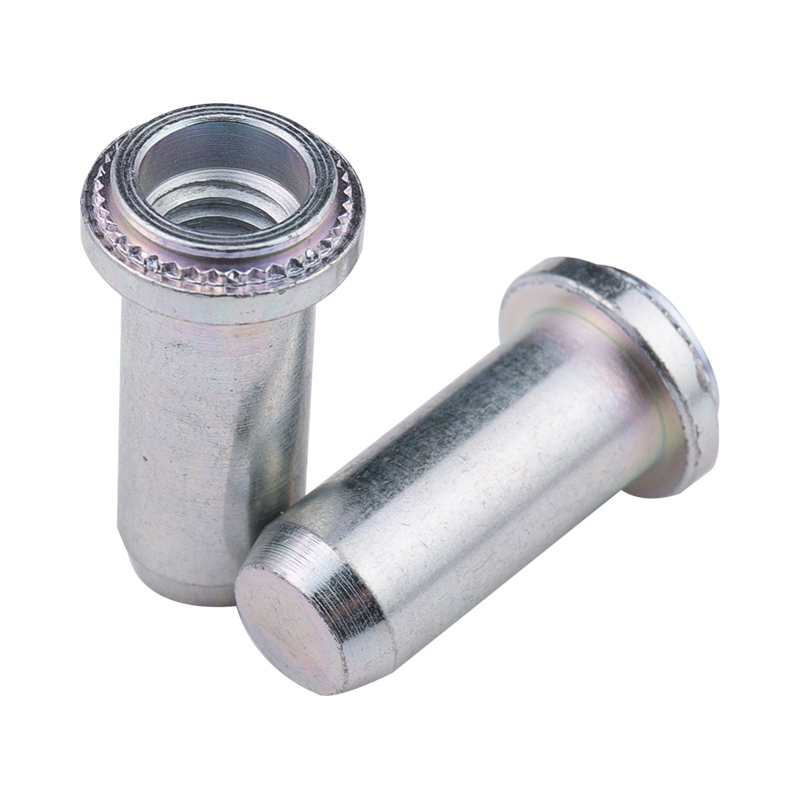
An automotive rivet nut is a connecting element used in automotive manufacturing. It is commonly used to connect different parts of the body structure, such as doors, bonnets, bumpers, etc. Rivet nut can provide a solid connection during the automotive manufacturing process and has a certain resistance to vibration and shock to adapt to various road conditions when the car is in motion. Automotive Rivet Nuts are manufactured from carbon steel with sufficient strength and hardness to ensure a reliable and durable connection. Its structure is designed in the shape of a rivet with threads that can easily penetrate the material to be joined and form a strong connection. It is usually pressed or fixed into the vehicle structure by mechanical pressure or pneumatic tools during installation to achieve a solid connection. The surface is usually specially treated to provide good corrosion resistance and to maintain the stability of the connection over a long period of time in automotive use.
We have our own Automotive Rivet Nuts factory in China, so we can OEM/ODM standard and non-standard fasteners, Precision Hardware Parts and accessories. We export and wholesale Automotive Rivet Nuts since 2006.
About
Kunshan Hong Yong Sheng Precision Hardware Products Co.,Ltd.
Kunshan Hong Yongsheng Precision Hardware Products Co., Ltd. was established in September 2006, is a professional China Automotive Rivet Nuts manufacturer and factory, the production of various types of precision parts, PEM series of standard fasteners, non-standard parts of the custom enterprise, the company's production equipment imported from Japan CNC computer numerically-controlled lathes, Taiwan CAM walking knife type high-precision automatic lathes, and various types of auxiliary equipment, precision testing equipment, totaling more than 100 units, monthly output of up to 5 million pieces. Our products are used in many fields such as electronic communications, computer monitors and chassis, automotive parts, 3C household appliances, medical equipment, pneumatic machinery, sports equipment, furniture, lighting, aerospace, military, photovoltaic, intelligent industry and so on, and we have the technical ability to develop new products.
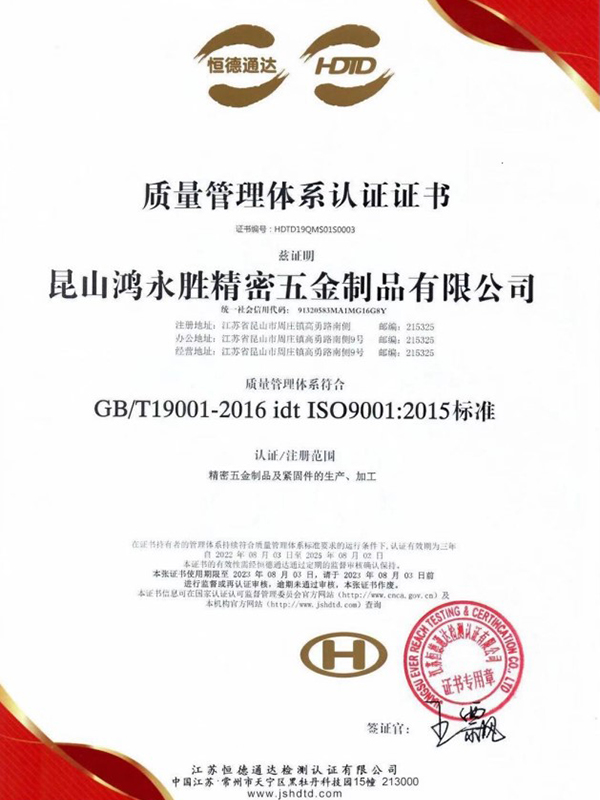
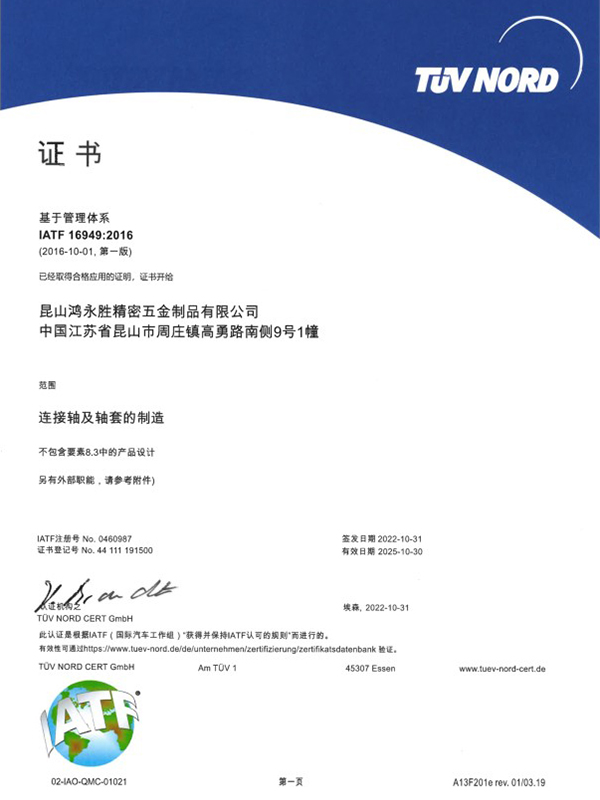
The company has obtained two quality system management certificates of ISO9001:2015 and IATF16949:2016.
At present, the company has been for Japan, Sweden, the United States, Singapore, Malaysia, Hong Kong and the Pearl River Delta and many other customers to provide services, now the main customers are: Japan Sharp (SHARP), Japan SMC, Japan Panasonic (Panasonic), the Swedish automobile VOVOL, etc., all the fixed assets investment of more than 30 million dollars, welcome friends from all walks of life to the factory to visit, study, consulting and come! We welcome friends from all walks of life to visit our factory, investigate, consult and come to us for sample processing.
We are looking forward to establishing a good business partnership with you with mutual trust and reciprocity!
The company has obtained two quality system management certificates of ISO9001:2015 and IATF16949:2016.
At present, the company has been for Japan, Sweden, the United States, Singapore, Malaysia, Hong Kong and the Pearl River Delta and many other customers to provide services, now the main customers are: Japan Sharp (SHARP), Japan SMC, Japan Panasonic (Panasonic), the Swedish automobile VOVOL, etc., all the fixed assets investment of more than 30 million dollars, welcome friends from all walks of life to the factory to visit, study, consulting and come! We welcome friends from all walks of life to visit our factory, investigate, consult and come to us for sample processing.
We are looking forward to establishing a good business partnership with you with mutual trust and reciprocity!
Certificate Of Honor
News
-
-
Imagine you are sourcing a precision shaft that carries a bearing on one end and slides through a hydraulic seal along its length. The drawing shows a circularity tolerance of 0.01 mm on the bearing ...
READ MORE -
What Is a Steel Sleeve and Where It Is Used A steel sleeve is a hollow cylindrical component used to protect a shaft, reduce friction, provide a wear-resistant bearing surface, or act as a spacer betw...
READ MORE -
When you have a batch of cylindrical components to machine, the CNC turning lathe is usually the first machine tool that comes to mind. It solves a straightforward problem: rotate the workpiece while...
READ MORE
Automotive Rivet Nuts Industry knowledge
What are the different installation methods available for automotive rivet nuts?
Automotive rivet nuts can be installed using various methods, depending on the application requirements, the type of rivet nut, and the available tools. Here are some common installation methods:
Manual Installation with Hand Tools
Hand Rivet Nut Tools: These tools are specifically designed for installing rivet nuts manually. They usually have a threaded mandrel that screws into the rivet nut. When the handles are squeezed, the tool pulls the mandrel, causing the rivet nut to expand and secure itself in the material.
Nutserts with Wrenches: For smaller jobs, a simple combination of a bolt, a nut, and two wrenches can be used. The bolt is threaded through the rivet nut, and the nut is tightened against the rivet nut while holding the bolt steady. As the nut is tightened, the rivet nut is pulled and deformed to secure it in place.
Pneumatic Installation
Pneumatic Rivet Nut Tools: These air-powered tools are used for faster and more consistent installation of rivet nuts, especially in high-volume applications. The tool uses compressed air to pull the mandrel, ensuring quick and uniform expansion of the rivet nut. Pneumatic tools are ideal for assembly lines and industrial settings.
Hydraulic Installation
Hydraulic Rivet Nut Tools: Similar to pneumatic tools, hydraulic tools use hydraulic pressure to install rivet nuts. They are often used for heavy-duty applications where higher installation forces are required. Hydraulic tools provide precise control and are suitable for large-scale manufacturing processes.
Battery-Powered Installation
Battery-Powered Rivet Nut Tools: These cordless tools offer mobility and ease of use, combining the power of pneumatic or hydraulic tools with the convenience of battery operation. They are suitable for various installation environments, including on-site and remote locations.
Automatic Installation
Automated Rivet Nut Machines: In high-volume production environments, fully automated machines can install rivet nuts efficiently and accurately. These machines are integrated into assembly lines and can be programmed to install rivet nuts at specific intervals and positions, ensuring consistency and speed.
Spin-Spin Installation
Spin-Spin Tools: These tools use a spinning action to install rivet nuts. The mandrel spins and pulls simultaneously, causing the rivet nut to expand and grip the material. Spin-spin installation is fast and efficient, often used in automated or semi-automated setups.
Spin-Pull Installation
Spin-Pull Tools: In this method, the tool spins the mandrel to thread it into the rivet nut, then pulls to deform and set the rivet nut in place. Spin-pull tools provide precise control over the installation process and are used in various industrial applications.
Impact Wrench Installation
Impact Wrenches: For certain heavy-duty rivet nuts, impact wrenches can be used to provide the necessary torque to install the rivet nut. The impact action helps to secure the rivet nut in thicker or harder materials.
Each of these methods has its advantages and is chosen based on the specific requirements of the application, such as the volume of installations, the type of materials being used, and the desired speed and consistency of the installation process.

If you are interested in our products, please consult us
Kunshan Hong Yong Sheng Precision Hardware Products Co.,Ltd. All Rights Reserved. OEM/ODM Automotive Rivet Nuts Manufacturer