

 русский
 Español
 中文简体
中文简体

CNC Threading Guide: Methods, Standards, Tolerances, and Sourcing Advice
Industry News-A single M5 thread, 12 mm deep in an aluminum actuator housing, either passes a GO/NO-GO gauge or sends the entire batch back to the supplier. That outcome is settled before inspection begins, by how the thread was cut. CNC threading covers every numerically controlled method used to produce a helical thread: single-point turning on a lathe, tapping, thread milling on a machining center, and chipless forming by rolling. The chosen method drives thread strength, achievable tolerance, cycle time, and unit cost. The practical conclusion comes first: threads on standard fasteners are almost always cheaper to buy finished than to machine, while CNC threading earns its keep when the thread is an integral feature of a custom part, or when non-standard pitches, materials, and thread forms are required.
Content
What CNC Threading Actually Involves
CNC threading removes material, or displaces it in the case of rolling, to create a helical ridge with a defined profile, pitch, and tolerance class. On a lathe, spindle rotation and axial tool feed are synchronized electronically: for every spindle revolution, the tool advances exactly one pitch, which means 1.5 mm per revolution on an M10x1.5 thread. No single pass reaches full depth, so the control drives the tool through several progressively deeper passes until the profile lands in size. Threads belong to two families: external threads, such as the shank of a bolt or stud, and internal threads, such as the bore of a nut or a tapped hole in a housing.
The parameters that define any thread
- Major diameter: the largest diameter of the thread form, nominally 10.0 mm on an M10 thread.
- Pitch: the axial distance between adjacent crests. On single-start threads, pitch equals lead.
- Flank angle: 60 degrees included on ISO metric and UN series threads, which is why insert geometry must match the thread family being cut.
- Pitch diameter: the effective diameter where mating flanks contact. This is the dimension gauges actually verify, and the one that decides whether assembly is smooth or binding.
The Main Threading Methods and Where Each Fits
Single-point thread turning
A lathe traces the profile with a V-form insert, keeping spindle and Z-axis motion in sync. Because the insert geometry, not a dedicated tap or die, defines the thread, one tooling station can cut M20x2.5 in the morning and a 1 mm extra-fine pitch after lunch. It is the most flexible method for external threads and larger internal threads, at the cost of longer cycle times than forming.
Tapping
For small internal threads, tapping remains the fastest route. A tap cuts its way through the hole in one spindle-synchronized cycle, which is why it dominates high-volume production in the M2 to M16 range. The failure mode is equally well known: a broken tap in a blind hole of a nearly finished housing is one of the most expensive scrap events in machining, especially in work-hardening stainless steels.
Thread milling
A thread mill on a machining center interpolates the thread helically, orbiting the tool as it rises through the hole. One tool then covers a range of diameters, cutting forces stay low enough for thin walls, and threads can be milled close to the bottom of a blind hole. Because the tool is smaller than the finished thread, a chipped insert no longer ruins the part. The trade-offs are slower cycles in small sizes and the need for helical interpolation on the control.
Thread rolling and grinding
Rolling forms the thread by displacing material between dies. Cold work aligns the grain and raises fatigue strength, the surface comes out smooth, and there are no chips, which is why high-volume studs and bolts are rolled rather than cut. Grinding cuts hardened steel after heat treatment and delivers the tightest pitch-diameter control at the highest cost per thread, so it is reserved for precision lead screws, gauges, and safety-critical hardware.
| Method | Typical application | Key strengths | Limitations to plan around |
|---|---|---|---|
| Single-point turning | External and large internal threads on lathes | One insert profile covers many pitches; flexible for custom work | Slower cycle times; pass strategy affects finish |
| Tapping | Small internal threads in volume production | Fast, simple, repeatable in one cycle | Tap breakage risk in blind holes and gummy alloys |
| Thread milling | Internal threads on machining centers, large diameters, threads near shoulders | One tool covers many diameters; low cutting forces | Needs helical interpolation; slower in small sizes |
| Thread rolling | High-volume studs, bolts, and screws | Stronger cold-worked threads; smooth surface; no chips | Requires ductile material; unsuitable for one-offs |
| Thread grinding | Hardened precision parts and lead screws | Tightest accuracy after heat treatment | Highest cost per thread |
Thread Standards Worth Quoting Exactly
Most engineering threads today are ISO metric M threads, standardized in ISO 261 and DIN 13. Coarse pitch is the default, such as M10x1.5 or M14x2, and it should be your starting point because coarse threads machine faster, assemble faster, and tolerate handling damage better. Fine and extra-fine pitches such as M14x1.5 or M14x1 earn their place where vibration resistance, thin-wall strength, or fine axial adjustment matters. Tolerance class matters as much as pitch: 6H for internal threads and 6g for external threads is the general-purpose pairing, while tighter classes such as 5H or 4g serve precision fits. One practical warning: if the part will be zinc plated, the external thread needs a plating allowance, because a few microns of coating per flank is enough to turn a 6g bolt into one that binds a 6H nut. Inch-based UNC and UNF threads still serve North American equipment and legacy machinery, so replacement hardware must match them exactly.
Power transmission threads follow their own family. Trapezoidal profiles with a 30-degree flank angle, standardized in DIN 103 and ISO 2904, carry motion in lead screws, press spindles, and valve stems where high axial loads and long service life matter more than quick assembly. A drawing for a machine adjustment axis, for example, may call for a trapezoidal profile machined onto a stepped feature, like this trapezoidal threaded stepped shaft produced to customer specification.
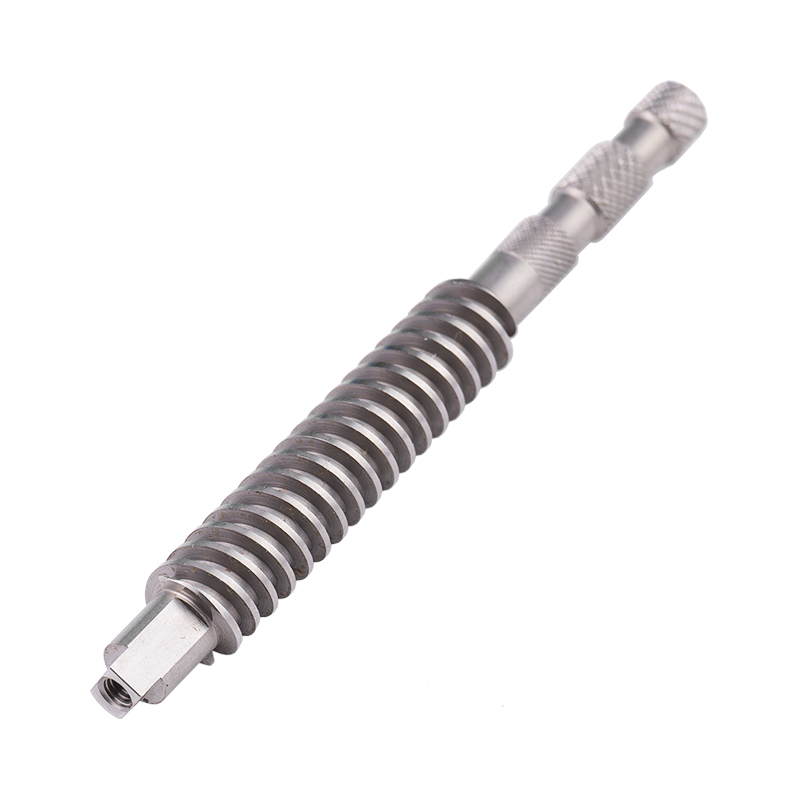 Custom Knurled Threaded Stepped Shaft for Power TransmissionTurned from stainless steel with a knurled end and internally threaded spiral section, this custom stepped shaft suits lead screws and adjustment axes, where the article's trapezoidal thread rules for drawing quality apply directly.View Product →
Design Decisions That Prevent Expensive Rework
Most thread-related quality problems trace back to the drawing, not the machine. Six rules eliminate the usual failures:
- Set engagement length at roughly 1 to 1.5 times the nominal diameter in metal, and 2 to 3 times in plastics or other soft materials.
- Specify a relief groove, or an allowable incomplete-thread length, wherever a thread runs against a shoulder; forcing a full thread to a face is a classic cause of interference at assembly.
- Chamfer the entry by about 1 to 1.5 pitches so the mating part starts cleanly and the first thread is not damaged during installation.
- In blind holes, allow two to three pitches of run-out below the required full-thread depth, because no cutting process produces perfect threads to the very bottom.
- State the pitch explicitly on the drawing, even for coarse threads; a callout that reads only M14 invites a shop to assume 2 mm when the design intent was 1.5 mm.
- Decide whether the tolerance class applies before or after coating, and write it on the drawing.
When the base material cannot hold a durable thread, such as thin sheet, slender aluminum bosses, or plastic housings, the standard remedy is a metal insert rather than an oversized boss. A brass hex threaded insert coupling nut provides a wear-resistant internal thread that survives repeated assembly cycles, and brass runs gently against the stainless or steel screw it mates with.
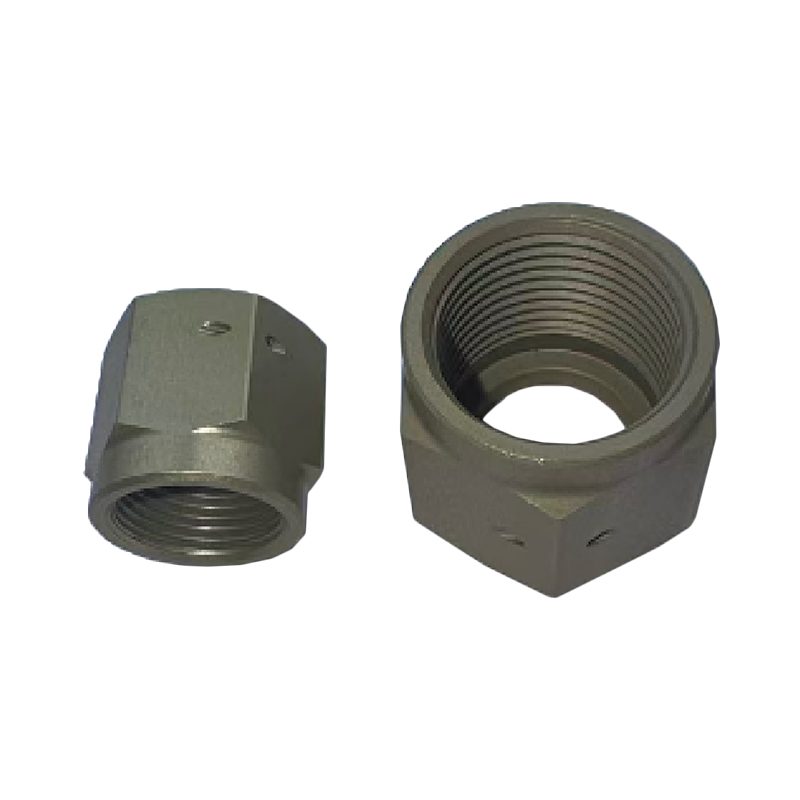 Brass Hex Threaded Insert Coupling Nut with Internal and External ThreadsThis precision-machined brass coupling nut offers dual internal and external threads, corrosion resistance, and strong wrench grip, making it ideal for adding durable threads in sheet metal, aluminum, or plastic housings.View Product →
Machine the Thread or Buy the Fastener?
The decision rule is straightforward. If the thread exists on a standard part, such as a DIN 912 socket screw, a DIN 934 hex nut, or an ISO 4014 hex bolt, buying the finished fastener is dramatically cheaper than machining it, and cold-formed parts carry rolled threads that are stronger than most cut threads. CNC threading becomes the right answer when the thread is integrated into custom geometry, when the pitch or material is outside the catalog, or when volumes are too low to justify cold-heading tooling.
The buying logic flips as soon as a drawing leaves the standard series. An extra-fine pitch, an unusual material such as brass or alloy structural steel, or a stud combining a hex head, a plain shank, and a special thread all point to lathe threading rather than a fastener shelf. An M14x1 hex head threaded stud illustrates the middle ground: the geometry is simple enough for economical batch production, yet the extra-fine pitch means it will never appear in a standard catalog range.
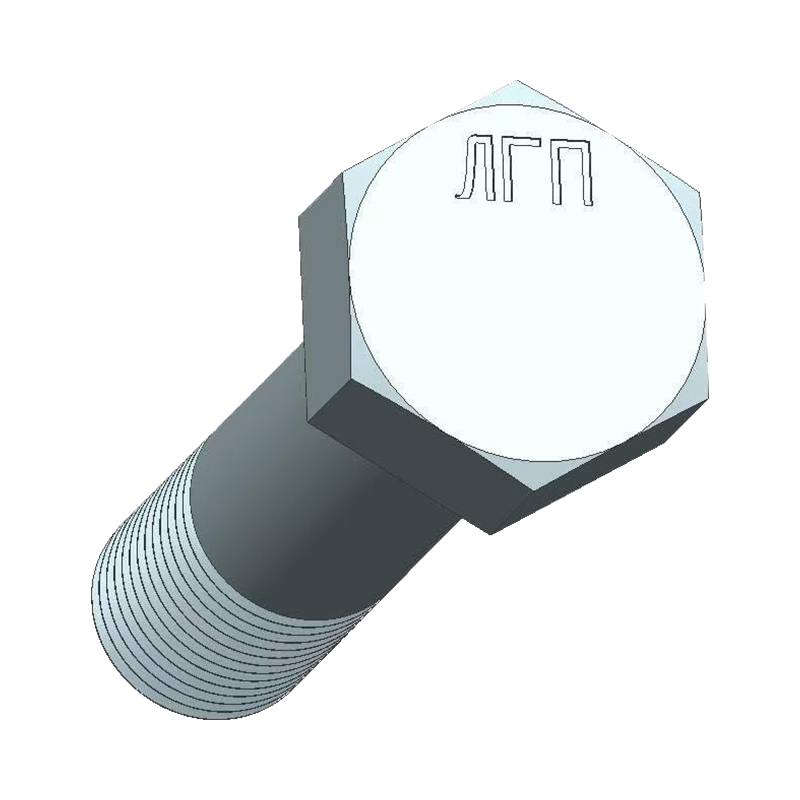 M14 x L Hex Head Threaded Stud in Carbon SteelMachined to customer drawings, this hex head stud with extra-fine thread shows why CNC threading beats catalog fasteners when pitch or geometry falls outside standard series, while remaining economical in batch production.View Product →
As a manufacturer that runs both production models, Kunshan Hong Yong Sheng Precision Hardware supplies DIN and ISO standard fasteners in volume and machines non-standard threaded components to customer drawings, so each line item can be quoted through whichever route genuinely costs less.
How Threaded Parts Are Verified Before Shipment
Threaded features are inspected with the same discipline as any other precision dimension: GO/NO-GO plug and ring gauges confirm functional fit against the specified tolerance class, the three-wire method or a thread micrometer measures pitch diameter, and optical projection checks flank angle and crest condition. Torque-preload testing adds a final layer for safety-relevant joints. For a closer look at the measurement practices behind consistent batches, this article on how Kunshan Hong Yong Sheng ensures dimensional accuracy walks through the inspection and process controls involved.
Where Threaded Precision Pays Off
Threaded components carry the most responsibility wherever vibration, safety, or fine adjustment is involved. Automotive assemblies rely on studs and insert nuts that hold torque through temperature swings; aerospace hardware favors fine pitches and self-locking designs to resist loosening; hydraulic and pneumatic equipment depends on accurately cut adjustment threads for repeatable metering; and medical device housings need small, burr-free internal threads that assemble smoothly without shedding particles.
The takeaway is simple: define the thread completely, including pitch, tolerance class, engagement length, and coating order, then choose the cheapest process that meets it. Buy standard threaded fasteners wherever a DIN or ISO part exists, reserve CNC threading for custom geometry and non-standard callouts, and work with a supplier who can produce both, so the process decision follows the part rather than the other way around.
Our Products //
Hot Products

If you are interested in our products, please consult us
Kunshan Hong Yong Sheng Precision Hardware Products Co.,Ltd. All Rights Reserved. Customised Fastener Manufacturer in China
